{
"cells": [
{
"cell_type": "markdown",
"id": "b9f10712",
"metadata": {
"origin_pos": 0
},
"source": [
"# 含并行连结的网络(GoogLeNet)\n",
":label:`sec_googlenet`\n",
"\n",
"在2014年的ImageNet图像识别挑战赛中,一个名叫*GoogLeNet* :cite:`Szegedy.Liu.Jia.ea.2015`的网络架构大放异彩。\n",
"GoogLeNet吸收了NiN中串联网络的思想,并在此基础上做了改进。\n",
"这篇论文的一个重点是解决了什么样大小的卷积核最合适的问题。\n",
"毕竟,以前流行的网络使用小到$1 \\times 1$,大到$11 \\times 11$的卷积核。\n",
"本文的一个观点是,有时使用不同大小的卷积核组合是有利的。\n",
"本节将介绍一个稍微简化的GoogLeNet版本:我们省略了一些为稳定训练而添加的特殊特性,现在有了更好的训练方法,这些特性不是必要的。\n",
"\n",
"## (**Inception块**)\n",
"\n",
"在GoogLeNet中,基本的卷积块被称为*Inception块*(Inception block)。这很可能得名于电影《盗梦空间》(Inception),因为电影中的一句话“我们需要走得更深”(“We need to go deeper”)。\n",
"\n",
"\n",
":label:`fig_inception`\n",
"\n",
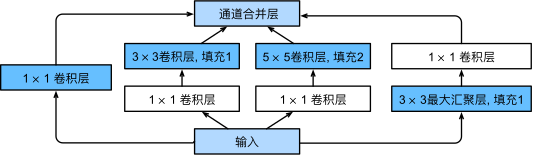
"如 :numref:`fig_inception`所示,Inception块由四条并行路径组成。\n",
"前三条路径使用窗口大小为$1\\times 1$、$3\\times 3$和$5\\times 5$的卷积层,从不同空间大小中提取信息。\n",
"中间的两条路径在输入上执行$1\\times 1$卷积,以减少通道数,从而降低模型的复杂性。\n",
"第四条路径使用$3\\times 3$最大汇聚层,然后使用$1\\times 1$卷积层来改变通道数。\n",
"这四条路径都使用合适的填充来使输入与输出的高和宽一致,最后我们将每条线路的输出在通道维度上连结,并构成Inception块的输出。在Inception块中,通常调整的超参数是每层输出通道数。\n"
]
},
{
"cell_type": "code",
"execution_count": 1,
"id": "82e98083",
"metadata": {
"execution": {
"iopub.execute_input": "2023-08-18T07:18:45.698938Z",
"iopub.status.busy": "2023-08-18T07:18:45.698048Z",
"iopub.status.idle": "2023-08-18T07:18:49.844955Z",
"shell.execute_reply": "2023-08-18T07:18:49.843595Z"
},
"origin_pos": 2,
"tab": [
"pytorch"
]
},
"outputs": [],
"source": [
"import torch\n",
"from torch import nn\n",
"from torch.nn import functional as F\n",
"from d2l import torch as d2l\n",
"\n",
"\n",
"class Inception(nn.Module):\n",
" # c1--c4是每条路径的输出通道数\n",
" def __init__(self, in_channels, c1, c2, c3, c4, **kwargs):\n",
" super(Inception, self).__init__(**kwargs)\n",
" # 线路1,单1x1卷积层\n",
" self.p1_1 = nn.Conv2d(in_channels, c1, kernel_size=1)\n",
" # 线路2,1x1卷积层后接3x3卷积层\n",
" self.p2_1 = nn.Conv2d(in_channels, c2[0], kernel_size=1)\n",
" self.p2_2 = nn.Conv2d(c2[0], c2[1], kernel_size=3, padding=1)\n",
" # 线路3,1x1卷积层后接5x5卷积层\n",
" self.p3_1 = nn.Conv2d(in_channels, c3[0], kernel_size=1)\n",
" self.p3_2 = nn.Conv2d(c3[0], c3[1], kernel_size=5, padding=2)\n",
" # 线路4,3x3最大汇聚层后接1x1卷积层\n",
" self.p4_1 = nn.MaxPool2d(kernel_size=3, stride=1, padding=1)\n",
" self.p4_2 = nn.Conv2d(in_channels, c4, kernel_size=1)\n",
"\n",
" def forward(self, x):\n",
" p1 = F.relu(self.p1_1(x))\n",
" p2 = F.relu(self.p2_2(F.relu(self.p2_1(x))))\n",
" p3 = F.relu(self.p3_2(F.relu(self.p3_1(x))))\n",
" p4 = F.relu(self.p4_2(self.p4_1(x)))\n",
" # 在通道维度上连结输出\n",
" return torch.cat((p1, p2, p3, p4), dim=1)"
]
},
{
"cell_type": "markdown",
"id": "67ed1e2a",
"metadata": {
"origin_pos": 5
},
"source": [
"那么为什么GoogLeNet这个网络如此有效呢?\n",
"首先我们考虑一下滤波器(filter)的组合,它们可以用各种滤波器尺寸探索图像,这意味着不同大小的滤波器可以有效地识别不同范围的图像细节。\n",
"同时,我们可以为不同的滤波器分配不同数量的参数。\n",
"\n",
"## [**GoogLeNet模型**]\n",
"\n",
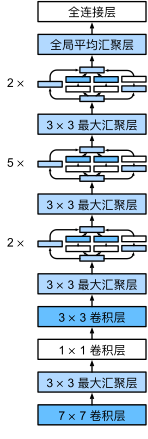
"如 :numref:`fig_inception_full`所示,GoogLeNet一共使用9个Inception块和全局平均汇聚层的堆叠来生成其估计值。Inception块之间的最大汇聚层可降低维度。\n",
"第一个模块类似于AlexNet和LeNet,Inception块的组合从VGG继承,全局平均汇聚层避免了在最后使用全连接层。\n",
"\n",
"\n",
":label:`fig_inception_full`\n",
"\n",
"现在,我们逐一实现GoogLeNet的每个模块。第一个模块使用64个通道、$7\\times 7$卷积层。\n"
]
},
{
"cell_type": "code",
"execution_count": 2,
"id": "4278ba0a",
"metadata": {
"execution": {
"iopub.execute_input": "2023-08-18T07:18:49.850742Z",
"iopub.status.busy": "2023-08-18T07:18:49.849860Z",
"iopub.status.idle": "2023-08-18T07:18:49.877802Z",
"shell.execute_reply": "2023-08-18T07:18:49.876517Z"
},
"origin_pos": 7,
"tab": [
"pytorch"
]
},
"outputs": [],
"source": [
"b1 = nn.Sequential(nn.Conv2d(1, 64, kernel_size=7, stride=2, padding=3),\n",
" nn.ReLU(),\n",
" nn.MaxPool2d(kernel_size=3, stride=2, padding=1))"
]
},
{
"cell_type": "markdown",
"id": "b4d6d53a",
"metadata": {
"origin_pos": 10
},
"source": [
"第二个模块使用两个卷积层:第一个卷积层是64个通道、$1\\times 1$卷积层;第二个卷积层使用将通道数量增加三倍的$3\\times 3$卷积层。\n",
"这对应于Inception块中的第二条路径。\n"
]
},
{
"cell_type": "code",
"execution_count": 3,
"id": "d5a1d1b0",
"metadata": {
"execution": {
"iopub.execute_input": "2023-08-18T07:18:49.883499Z",
"iopub.status.busy": "2023-08-18T07:18:49.882740Z",
"iopub.status.idle": "2023-08-18T07:18:49.892430Z",
"shell.execute_reply": "2023-08-18T07:18:49.891290Z"
},
"origin_pos": 12,
"tab": [
"pytorch"
]
},
"outputs": [],
"source": [
"b2 = nn.Sequential(nn.Conv2d(64, 64, kernel_size=1),\n",
" nn.ReLU(),\n",
" nn.Conv2d(64, 192, kernel_size=3, padding=1),\n",
" nn.ReLU(),\n",
" nn.MaxPool2d(kernel_size=3, stride=2, padding=1))"
]
},
{
"cell_type": "markdown",
"id": "c5532216",
"metadata": {
"origin_pos": 15
},
"source": [
"第三个模块串联两个完整的Inception块。\n",
"第一个Inception块的输出通道数为$64+128+32+32=256$,四个路径之间的输出通道数量比为$64:128:32:32=2:4:1:1$。\n",
"第二个和第三个路径首先将输入通道的数量分别减少到$96/192=1/2$和$16/192=1/12$,然后连接第二个卷积层。第二个Inception块的输出通道数增加到$128+192+96+64=480$,四个路径之间的输出通道数量比为$128:192:96:64 = 4:6:3:2$。\n",
"第二条和第三条路径首先将输入通道的数量分别减少到$128/256=1/2$和$32/256=1/8$。\n"
]
},
{
"cell_type": "code",
"execution_count": 4,
"id": "11b7cf54",
"metadata": {
"execution": {
"iopub.execute_input": "2023-08-18T07:18:49.897526Z",
"iopub.status.busy": "2023-08-18T07:18:49.896704Z",
"iopub.status.idle": "2023-08-18T07:18:49.916207Z",
"shell.execute_reply": "2023-08-18T07:18:49.915075Z"
},
"origin_pos": 17,
"tab": [
"pytorch"
]
},
"outputs": [],
"source": [
"b3 = nn.Sequential(Inception(192, 64, (96, 128), (16, 32), 32),\n",
" Inception(256, 128, (128, 192), (32, 96), 64),\n",
" nn.MaxPool2d(kernel_size=3, stride=2, padding=1))"
]
},
{
"cell_type": "markdown",
"id": "f54c6828",
"metadata": {
"origin_pos": 20
},
"source": [
"第四模块更加复杂,\n",
"它串联了5个Inception块,其输出通道数分别是$192+208+48+64=512$、$160+224+64+64=512$、$128+256+64+64=512$、$112+288+64+64=528$和$256+320+128+128=832$。\n",
"这些路径的通道数分配和第三模块中的类似,首先是含$3×3$卷积层的第二条路径输出最多通道,其次是仅含$1×1$卷积层的第一条路径,之后是含$5×5$卷积层的第三条路径和含$3×3$最大汇聚层的第四条路径。\n",
"其中第二、第三条路径都会先按比例减小通道数。\n",
"这些比例在各个Inception块中都略有不同。\n"
]
},
{
"cell_type": "code",
"execution_count": 5,
"id": "b55bd896",
"metadata": {
"execution": {
"iopub.execute_input": "2023-08-18T07:18:49.921459Z",
"iopub.status.busy": "2023-08-18T07:18:49.920668Z",
"iopub.status.idle": "2023-08-18T07:18:49.984376Z",
"shell.execute_reply": "2023-08-18T07:18:49.982781Z"
},
"origin_pos": 22,
"tab": [
"pytorch"
]
},
"outputs": [],
"source": [
"b4 = nn.Sequential(Inception(480, 192, (96, 208), (16, 48), 64),\n",
" Inception(512, 160, (112, 224), (24, 64), 64),\n",
" Inception(512, 128, (128, 256), (24, 64), 64),\n",
" Inception(512, 112, (144, 288), (32, 64), 64),\n",
" Inception(528, 256, (160, 320), (32, 128), 128),\n",
" nn.MaxPool2d(kernel_size=3, stride=2, padding=1))"
]
},
{
"cell_type": "markdown",
"id": "2a44e596",
"metadata": {
"origin_pos": 25
},
"source": [
"第五模块包含输出通道数为$256+320+128+128=832$和$384+384+128+128=1024$的两个Inception块。\n",
"其中每条路径通道数的分配思路和第三、第四模块中的一致,只是在具体数值上有所不同。\n",
"需要注意的是,第五模块的后面紧跟输出层,该模块同NiN一样使用全局平均汇聚层,将每个通道的高和宽变成1。\n",
"最后我们将输出变成二维数组,再接上一个输出个数为标签类别数的全连接层。\n"
]
},
{
"cell_type": "code",
"execution_count": 6,
"id": "8fc4cc33",
"metadata": {
"execution": {
"iopub.execute_input": "2023-08-18T07:18:49.990643Z",
"iopub.status.busy": "2023-08-18T07:18:49.989777Z",
"iopub.status.idle": "2023-08-18T07:18:50.042949Z",
"shell.execute_reply": "2023-08-18T07:18:50.041737Z"
},
"origin_pos": 27,
"tab": [
"pytorch"
]
},
"outputs": [],
"source": [
"b5 = nn.Sequential(Inception(832, 256, (160, 320), (32, 128), 128),\n",
" Inception(832, 384, (192, 384), (48, 128), 128),\n",
" nn.AdaptiveAvgPool2d((1,1)),\n",
" nn.Flatten())\n",
"\n",
"net = nn.Sequential(b1, b2, b3, b4, b5, nn.Linear(1024, 10))"
]
},
{
"cell_type": "markdown",
"id": "7e92ad19",
"metadata": {
"origin_pos": 30
},
"source": [
"GoogLeNet模型的计算复杂,而且不如VGG那样便于修改通道数。\n",
"[**为了使Fashion-MNIST上的训练短小精悍,我们将输入的高和宽从224降到96**],这简化了计算。下面演示各个模块输出的形状变化。\n"
]
},
{
"cell_type": "code",
"execution_count": 7,
"id": "51845ad5",
"metadata": {
"execution": {
"iopub.execute_input": "2023-08-18T07:18:50.048543Z",
"iopub.status.busy": "2023-08-18T07:18:50.047764Z",
"iopub.status.idle": "2023-08-18T07:18:50.254447Z",
"shell.execute_reply": "2023-08-18T07:18:50.252245Z"
},
"origin_pos": 32,
"tab": [
"pytorch"
]
},
"outputs": [
{
"name": "stdout",
"output_type": "stream",
"text": [
"Sequential output shape:\t torch.Size([1, 64, 24, 24])\n",
"Sequential output shape:\t torch.Size([1, 192, 12, 12])\n",
"Sequential output shape:\t torch.Size([1, 480, 6, 6])\n",
"Sequential output shape:\t torch.Size([1, 832, 3, 3])\n",
"Sequential output shape:\t torch.Size([1, 1024])\n",
"Linear output shape:\t torch.Size([1, 10])\n"
]
}
],
"source": [
"X = torch.rand(size=(1, 1, 96, 96))\n",
"for layer in net:\n",
" X = layer(X)\n",
" print(layer.__class__.__name__,'output shape:\\t', X.shape)"
]
},
{
"cell_type": "markdown",
"id": "1dfcf730",
"metadata": {
"origin_pos": 35
},
"source": [
"## [**训练模型**]\n",
"\n",
"和以前一样,我们使用Fashion-MNIST数据集来训练我们的模型。在训练之前,我们将图片转换为$96 \\times 96$分辨率。\n"
]
},
{
"cell_type": "code",
"execution_count": 8,
"id": "fe051d5b",
"metadata": {
"execution": {
"iopub.execute_input": "2023-08-18T07:18:50.260612Z",
"iopub.status.busy": "2023-08-18T07:18:50.259996Z",
"iopub.status.idle": "2023-08-18T07:22:36.284598Z",
"shell.execute_reply": "2023-08-18T07:22:36.283681Z"
},
"origin_pos": 36,
"tab": [
"pytorch"
]
},
"outputs": [
{
"name": "stdout",
"output_type": "stream",
"text": [
"loss 0.262, train acc 0.900, test acc 0.886\n",
"3265.5 examples/sec on cuda:0\n"
]
},
{
"data": {
"image/svg+xml": [
"\n",
"\n",
"\n"
],
"text/plain": [
""
]
},
"metadata": {
"needs_background": "light"
},
"output_type": "display_data"
}
],
"source": [
"lr, num_epochs, batch_size = 0.1, 10, 128\n",
"train_iter, test_iter = d2l.load_data_fashion_mnist(batch_size, resize=96)\n",
"d2l.train_ch6(net, train_iter, test_iter, num_epochs, lr, d2l.try_gpu())"
]
},
{
"cell_type": "markdown",
"id": "535046e9",
"metadata": {
"origin_pos": 37
},
"source": [
"## 小结\n",
"\n",
"* Inception块相当于一个有4条路径的子网络。它通过不同窗口形状的卷积层和最大汇聚层来并行抽取信息,并使用$1×1$卷积层减少每像素级别上的通道维数从而降低模型复杂度。\n",
"* GoogLeNet将多个设计精细的Inception块与其他层(卷积层、全连接层)串联起来。其中Inception块的通道数分配之比是在ImageNet数据集上通过大量的实验得来的。\n",
"* GoogLeNet和它的后继者们一度是ImageNet上最有效的模型之一:它以较低的计算复杂度提供了类似的测试精度。\n",
"\n",
"## 练习\n",
"\n",
"1. GoogLeNet有一些后续版本。尝试实现并运行它们,然后观察实验结果。这些后续版本包括:\n",
" * 添加批量规范化层 :cite:`Ioffe.Szegedy.2015`(batch normalization),在 :numref:`sec_batch_norm`中将介绍;\n",
" * 对Inception模块进行调整 :cite:`Szegedy.Vanhoucke.Ioffe.ea.2016`;\n",
" * 使用标签平滑(label smoothing)进行模型正则化 :cite:`Szegedy.Vanhoucke.Ioffe.ea.2016`;\n",
" * 加入残差连接 :cite:`Szegedy.Ioffe.Vanhoucke.ea.2017`。( :numref:`sec_resnet`将介绍)。\n",
"1. 使用GoogLeNet的最小图像大小是多少?\n",
"1. 将AlexNet、VGG和NiN的模型参数大小与GoogLeNet进行比较。后两个网络架构是如何显著减少模型参数大小的?\n"
]
},
{
"cell_type": "markdown",
"id": "cf7d384c",
"metadata": {
"origin_pos": 39,
"tab": [
"pytorch"
]
},
"source": [
"[Discussions](https://discuss.d2l.ai/t/1871)\n"
]
}
],
"metadata": {
"language_info": {
"name": "python"
},
"required_libs": []
},
"nbformat": 4,
"nbformat_minor": 5
}